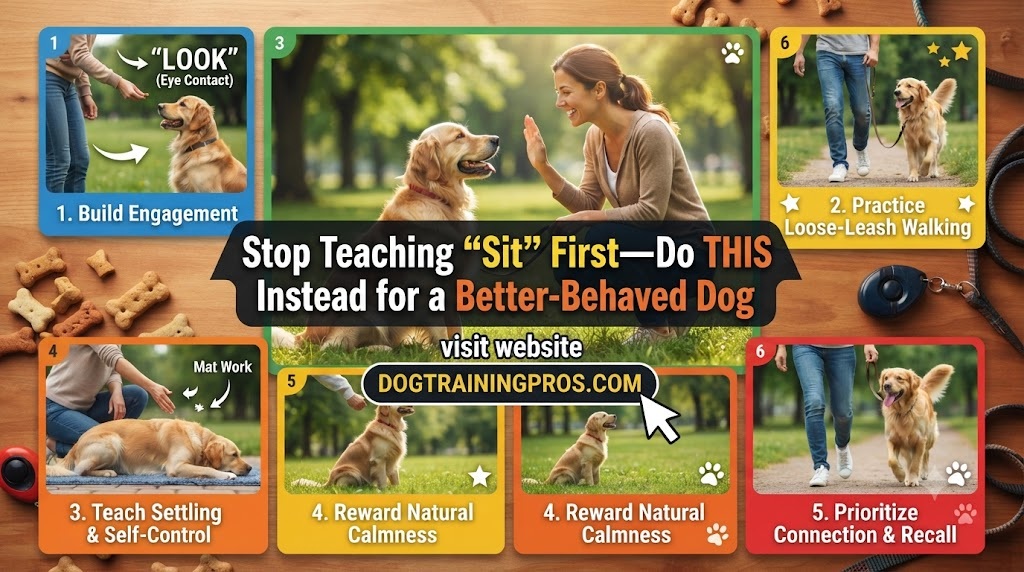
Stop Telling Your Dog to “Sit”: Why This Common Command is Failing You (and What to Do Instead)
For decades, the “Sit” command has been the holy grail of dog training. It is the first thing we teach puppies, the first thing we shout when a dog jumps on a guest, and the default behavior we expect at every street corner. We have been conditioned to believe that a sitting dog is an obedient dog.
But here is the hard truth that professional behaviorists and elite trainers have known for years: The “Sit” command is one of the most overused, misunderstood, and ultimately ineffective tools in your training arsenal.
If you have ever found yourself screaming “SIT!” at a dog that is currently lunging at a squirrel, or watched your dog’s butt hit the floor for half a second before they spring up to knock over a toddler, you know that “Sit” isn’t working. In fact, relying on “Sit” as your primary control mechanism might actually be hindering your dog’s ability to learn true impulse control and engagement.
It is time to move past the “Sit” myth. To get instant obedience and a dog that actually listens in high-distraction environments, you need to stop focusing on a physical posture and start focusing on a mental state.
The Problem with “Sit”: Why It’s a Training Dead End
To understand why “Sit” fails, we have to look at the mechanics of the command and how a dog perceives it.
1. It’s a Static Command for a Dynamic World
Most of the problems we want to solve—jumping, lunging, pulling, or bolting—are high-energy, dynamic behaviors. When we ask a dog to “Sit,” we are asking them to move into a static, stationary position while their brain is still operating at 100 miles per hour. This creates a massive internal conflict. The dog’s body is “parked,” but their mind is still “driving.” This is why dogs “pop” out of a sit the moment you look away; they haven’t actually calmed down; they’ve just paused their physical movement.
2. Physical Discomfort and Vulnerability
For many dogs, sitting isn’t actually comfortable. Large breeds like Great Danes or Greyhounds, or dogs with hip dysplasia or arthritis, can find the repetitive action of sitting physically taxing. Furthermore, in a high-stress environment (like a busy park with strange dogs), a “Sit” puts a dog in a vulnerable physical position. Asking a nervous dog to sit is like asking a person to sit in a chair while a bear walks into the room. It goes against their survival instincts, making them more likely to ignore the command.
3. Command Deafness
Because we use “Sit” for everything—before meals, at the door, at the curb, to say hi—the word often loses its value. It becomes background noise. If you say “Sit” five times before your dog actually does it, you have effectively taught your dog that “Sit” means “Do it whenever you feel like it, usually on the fifth time I say it.”
The “Instant Obedience” Alternative: The Engagement-First Approach
If “Sit” isn’t the answer, what is? The secret to instant obedience isn’t a new posture; it’s a Check-In.
The most powerful tool in modern dog training is the Default Engagement—teaching your dog that looking at you and checking in for information is more rewarding than anything else in the environment. Instead of micromanaging your dog’s body (telling them to sit, stay, or lie down), you should be managing their focus.
What is the “Check-In”?
The Check-In is a voluntary behavior where the dog chooses to orient their head and eyes toward you without being asked. When a dog checks in, they are saying, “I see that distraction, but I’m looking to you for direction.”
When you have a dog that checks in, you don’t need to tell them to sit when a guest walks through the door. They will look at you, stay calm, and wait for your next move. This is true obedience.
Step 1: Replace “Sit” with “The Focus Anchor”
The first thing you should do instead of “Sit” is the Hand Touch (also known as Targeting). This is the “THIS” that creates instant obedience.
Why “Touch” is Superior to “Sit”
- It Involves Movement: “Touch” requires the dog to move toward you. Movement helps dissipate nervous energy and redirects the dog’s momentum away from the distraction.
- It’s a Concrete Goal: “Sit” is a state of being. “Touch” is a specific task. For a dog’s brain, hitting a target with their nose is much more engaging and rewarding than simply holding a pose.
- It Positions the Dog: When you use a hand touch, you can move your dog anywhere you want without pulling on a leash. You can lead them away from a fight, away from a door, or into a heel position effortlessly.
How to Train the Perfect “Touch”
- Present the Target: Hold your palm out, fingers pointing down or sideways, about two inches from your dog’s nose.
- The Interaction: Most dogs will naturally sniff your hand. The second their nose touches your skin, say “YES!” (or click) and give a high-value treat.
- Add the Cue: Once the dog is reliably bumping your hand, add the verbal word “Touch” just as you present your hand.
- Increase Distance: Start moving your hand further away, requiring the dog to take a step or two to reach it.
- The “Obedience” Test: When your dog is distracted by something minor, call “Touch!” and present your hand. When they turn away from the distraction to bump your palm, you have achieved more control than a “Sit” could ever provide.
Step 2: Implement the “Place” Command for Home Sanity
While “Touch” is your go-to for walks and active management, the “Place” command is what replaces “Sit” inside the home.
If your dog sits when the doorbell rings, they are still right there at the door, ready to pounce. If you teach “Place,” the dog must go to a specific boundary (a bed, a rug, or a cot) and stay there until released.
The Power of Boundaries
“Place” is more effective than “Sit” because it provides a clear physical boundary. It tells the dog, “Your job is to be on this rug.” This creates a mental “off-switch.” While a sit is a temporary physical state, “Place” is a long-term duration task. It teaches the dog to self-regulate their emotions.
Training the “Place” Command
- Choose the Spot: Use a raised dog cot or a very specific rug that feels different from the rest of the floor.
- Lure the Dog: Use a treat to lure the dog onto the spot. As soon as all four paws are on, say “Place” and reward.
- Add Duration: Don’t let them off immediately. Feed several treats in a row while they remain on the “Place.”
- The Release Word: Use a word like “Break” or “Free” to tell them they can leave. Never let them leave the spot until they hear that word.
- The Result: When a guest arrives, instead of shouting “Sit!” at a frantic dog, you calmly say “Place.” The dog goes to their bed, settles their mind, and waits.
Step 3: Mastering the “Default Settle” (The Holy Grail)
The ultimate goal of training is to reach a point where you don’t have to give any commands. This is called the Default Settle.
Instead of telling your dog to “Sit” at the curb, you want a dog that arrives at the curb and automatically sits or stands quietly because they know that’s the rule of the environment.
Capturing Calm
To do this, you must stop rewarding only “active” obedience and start rewarding “passive” good behavior.
- Is your dog lying quietly while you watch TV? Drop a treat between their paws without saying a word.
- Did your dog look at a squirrel and then look back at you? “Yes!” and reward.
- Is your dog standing calmly while you put on your shoes? Reward.
When you reward the choice to be calm, the dog begins to default to that state. They no longer wait for a “Sit” command to behave; they behave because being calm is the most rewarding thing they can do.
Why Movement-Based Obedience Wins Every Time
Dogs are cursorial animals; they are designed to move. When we try to suppress that movement with “Sit” and “Stay” during moments of high arousal, we are fighting against biology.
The “Step-Back” Recall
Instead of telling your dog to sit when they are getting too excited on a walk, try the Step-Back.
- Say your dog’s name.
- Quickly take three fast steps backward away from the distraction.
- As your dog turns and runs toward you (engaging their prey drive in a positive way), reward them heavily when they reach you.
This creates an “instant obedience” loop. The dog learns that turning away from a distraction and moving toward you is a high-speed, high-reward game. A “Sit” is a buzzkill; a “Step-Back” is a party. Which one do you think your dog will listen to more reliably?
Real-World Scenarios: Applying “The New Way”
Let’s look at how replacing “Sit” works in the most common “fail” scenarios for dog owners.
Scenario A: The Over-Excited Greeting
- The Old Way: You scream “Sit!” as your dog jumps on your neighbor. The dog sits for a millisecond, then jumps again. The neighbor gets scratched, and you get frustrated.
- The New Way: As the neighbor approaches, you give the “Touch” command. Your dog focuses on hitting your hand with their nose, moving their body away from the neighbor to reach your hand. You then transition into a “Find it” (tossing treats on the ground). The dog’s head goes down to the ground to find treats. A dog with its head down cannot jump up.
Scenario B: The Reactive Walk
- The Old Way: You see another dog. You pull the leash tight and yell “SIT!” Your dog sits but is staring intently at the other dog, body stiff, hackles raised. Suddenly, the dog explodes in a barking fit.
- The New Way: You see the other dog. Before your dog reacts, you use the “Check-In” reward. You keep moving, changing direction, and using the “Touch” command to keep your dog’s mind on you. By keeping the dog in motion and focused on a task, you prevent the mental “lock-on” that leads to lunging.
Scenario C: The Doorbell
- The Old Way: “Sit! Sit! Fido, SIT!” while Fido is barking and scratching at the wood.
- The New Way: The doorbell rings. You say “Place.” Your dog runs to their raised cot in the living room. They stay there because “Place” means “stay until the release word,” not just “put your butt down for a second.” You open the door, greet your guest, and only when the dog is calm do you give the “Break” command.
The Science of Why “Sit” Can Increase Reactivity
Recent studies in canine behavior suggest that forcing a dog into a “Sit” or “Down” when they are afraid or over-stimulated can actually increase their cortisol levels.
When a dog is in a “Sit,” their ability to flee is compromised. If they feel threatened by a strange dog or a loud truck, being forced to sit can trigger a “fight” response because the “flight” option has been taken away by the owner. By allowing your dog to stand or move while remaining engaged with you, you keep their stress levels lower.
Movement is a stress-reliever for dogs. By using commands like “Touch,” “With Me,” or “Follow,” you are allowing the dog to process the environment while staying under your control.
5 Commands Every Dog Needs (That Aren’t “Sit”)
If you want a truly obedient dog, focus your training time on these five skills instead of obsessing over the “Sit.”
1. The “Middle” (Positioning)
Teach your dog to run and stand between your legs, facing forward. This is the ultimate “safety” position. It blocks the dog’s view of distractions and gives them a sense of security while putting you in total physical control without needing a leash.
2. “Watch Me” (Eye Contact)
The “Watch Me” command is about capturing the dog’s brain. If you have the eyes, you have the dog. Practice this in the kitchen, then the backyard, then the front porch, then the park.
3. “Leave It” (Impulse Control)
“Leave It” is not just for dropped food. It should mean “Disengage from whatever you are looking at and look at me.” A solid “Leave It” is a life-saver that provides more control than “Sit” ever could.
4. “Wait” (The Pause Button)
Unlike “Stay,” which is a formal command, “Wait” is a “pause button.” Use it at the car door, the food bowl, and the front door. It teaches the dog that they must check in for permission before moving forward.
5. “Touch” (The Redirection)
As discussed, this is your primary tool for moving your dog and breaking their focus on distractions.
How to Phase Out the “Sit” Crutch
Changing your training philosophy doesn’t happen overnight. Here is a 7-day plan to move from “Sit-Dependent” to “Engagement-Driven” obedience.
Days 1-2: The Foundation
- Stop asking for “Sit” entirely for 48 hours.
- Spend 10 minutes a day practicing the “Hand Touch.”
- Every time your dog naturally looks at you during a walk or in the house, say “Yes!” and give a treat. You are “marking” the engagement.
Days 3-4: Introducing Movement
- Start practicing “Touch” in different rooms and with minor distractions (like a squeaky toy on the floor).
- Introduce the “Step-Back” recall. Run away from your dog and have them chase you for a reward.
Days 5-6: Boundary Work
- Introduce the “Place” command. Use a high-value chew (like a bully stick) to encourage them to stay on the “Place” for longer periods.
- Practice the “Wait” command at every doorway.
Day 7: Real-World Testing
- Go for a walk. Instead of asking for a “Sit” at the curb, wait for the dog to voluntarily check in. When they look at you, reward them and cross the street.
- If you see a distraction, use “Touch” to guide them past it instead of trying to “park” them with a “Sit.”
When “Sit” IS Actually Useful
To be fair, the “Sit” command isn’t “wrong” in a vacuum—it’s just wrong as a primary tool for obedience. There are times when “Sit” is perfectly appropriate:
- At the Vet: During an exam, a sit or a down is often necessary for the vet to do their work.
- In Competitive Obedience: If you are competing in AKC or IPO trials, “Sit” is a required maneuver.
- Grooming: For brushing the chest or clipping certain nails.
The key is to treat “Sit” as a trick or a specific utility posture, not as a way to control your dog’s behavior in the real world.
Common Mistakes When Switching Methods
1. Not Being Interesting Enough
If you want your dog to check in with you instead of the squirrel, you have to be more interesting than the squirrel. This means using high-value rewards (chicken, cheese, tripe) and using an excited, engaging tone of voice.
2. Repeating the Cue
Whether it’s “Touch,” “Place,” or “Watch Me,” say it once. If the dog doesn’t do it, don’t repeat it. Instead, make the task easier (move closer to the dog) or increase the value of the reward. Repeating the cue creates the same “command deafness” we are trying to avoid with “Sit.”
3. Forgetting the Release Word
If you tell your dog to go to “Place,” but you don’t tell them when they can leave, they will eventually just get up on their own. This teaches them that they decide when the job is over. Always use a release word (“Break,” “Okay,” “Free”).
The Psychological Shift: From “Do It” to “What Should I Do?”
The biggest difference between “Sit-based” training and “Engagement-based” training is how the dog feels.
- Sit-based training is often about compliance. “I told you to sit, so sit.” It’s a top-down hierarchy.
- Engagement-based training is a conversation. It’s about building a partnership where the dog wants to know what you’re doing because you are the source of all things fun and rewarding.
When you stop forcing the “Sit” and start rewarding the “Check-In,” you will notice your dog’s tail wagging more. You’ll notice they are more relaxed. You’ll notice that they start anticipating your needs.
Conclusion: Reclaiming Your Relationship
The “Sit” command is a relic of a time when we didn’t fully understand canine psychology. We thought obedience was about physical control. Now we know that true obedience is about emotional regulation and mental focus.
By replacing “Sit” with The Focus Anchor (Touch), Boundary Training (Place), and The Default Settle, you are giving your dog the tools they need to succeed in a loud, distracting, and often scary world.
Stop barking “Sit” at a dog that isn’t listening. Start inviting them to engage with you. The “instant obedience” you’ve been looking for isn’t in your dog’s hindquarters—it’s in their mind.
The next time you’re out on a walk and your dog sees something exciting, don’t ask them to sit. Take a step back, offer your hand for a “Touch,” and watch as they choose you over the world. That is the moment you stop being a “handler” and start being a partner.
Summary Checklist for Instant Obedience:
- Ditch the “Sit” in high-arousal moments.
- Train “Touch” as your primary redirection tool.
- Use “Place” for long-term calmness at home.
- Reward Voluntary Eye Contact (The Check-In).
- Keep Moving to lower stress and maintain engagement.
- Use a Release Word to define exactly when a task ends.
Your dog doesn’t need to be a statue. They need to be a teammate. Start training for engagement today, and you’ll never have to scream “SIT!” again.