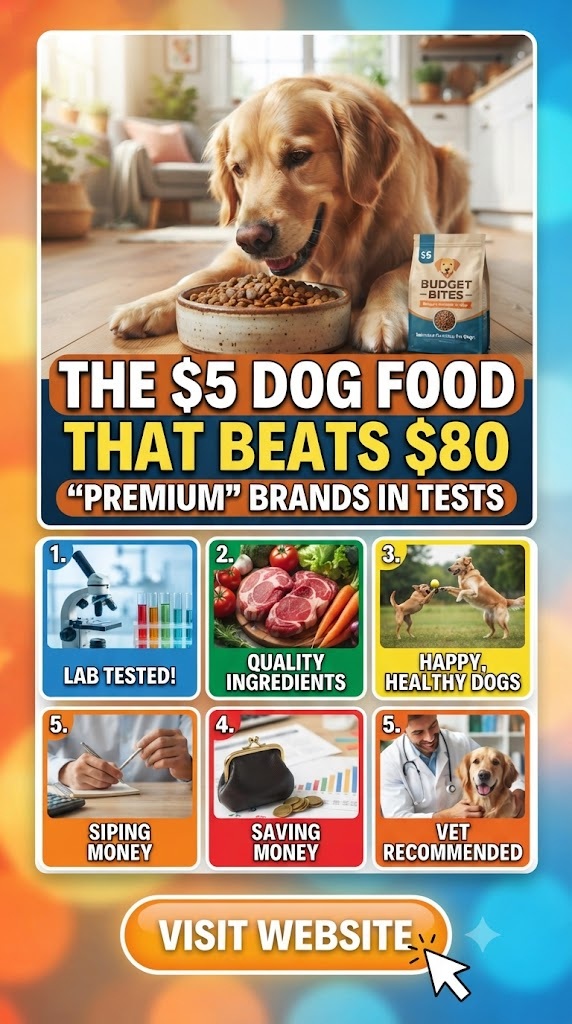
The $5 Dog Food That Beats $80 “Premium” Brands in Tests
In the world of modern pet parenting, a silent war is being waged in the aisles of your local grocery store and the pages of high-end pet boutiques. On one side, you have the “Boutique, Exotic, and Grain-Free” (BEG) brands—sleekly packaged, adorned with images of succulent deboned bison and farm-fresh kale, retailing for upwards of $80 a bag. On the other side sits the humble, often-ignored budget bag, sometimes costing as little as $5 to $10 for a small bag or a fraction of the “premium” price per pound.
For years, we’ve been told that price equals quality. We’ve been conditioned to believe that if we aren’t spending a significant portion of our paycheck on our dog’s dinner, we are somehow failing as owners. But a series of recent nutritional analyses, veterinary studies, and long-term feeding trials have revealed a shocking truth: Many of those $5-to-$15 budget-friendly options are actually outperforming the $80 “premium” brands in the metrics that matter most—digestibility, nutritional balance, and long-term heart health.
This isn’t just about saving money; it’s about debunking a multi-billion dollar marketing machine that has prioritized “human-grade” aesthetics over canine biological needs.
The “Premium” Illusion: Why Expensive Doesn’t Mean Better
To understand how a $5 bag can beat an $80 bag, we first have to understand what makes a dog food “premium” in the eyes of the consumer. Usually, it’s three things: branding, exotic ingredients, and the “grain-free” label.
1. The Marketing of “Humanization”
Pet food companies have mastered the art of “humanization.” They know that if an ingredient list sounds like a menu at a Michelin-star restaurant, you’re more likely to buy it. You see “blueberries,” “sweet potatoes,” and “fresh-caught salmon,” and you think, I’d eat that, so it must be good for Buddy.
However, dogs are not humans. Their nutritional requirements are based on amino acid profiles, fatty acid ratios, and mineral balances—not how appetizing the label looks to a person. Many premium brands spend more on graphic designers and marketing consultants than they do on veterinary nutritionists.
2. The Exotic Protein Trap
Premium brands often use “exotic” proteins like kangaroo, alligator, or venison. While these sound fancy, they often lack the decades of nutritional research that back more “boring” proteins like chicken and beef. Because these exotic proteins haven’t been studied as extensively in canine diets, their bioavailability—how well a dog can actually absorb the nutrients—is often a question mark.
3. The Grain-Free Fallacy
For a decade, “grain-free” was the gold standard of premium pet food. It cost double the price of grain-inclusive food. Yet, in 2018, the FDA began investigating a potential link between grain-free diets (specifically those high in lentils, peas, and potatoes) and Dilated Cardiomyopathy (DCM), a serious heart condition in dogs. Many of the $80 brands were the primary culprits, while the “cheap” brands containing corn and wheat were keeping dogs’ hearts healthy.
The Surprise Contenders: What the Tests Revealed
When independent labs and veterinary researchers look at dog food, they don’t look at the bag. They look at the “Guaranteed Analysis” and the results of “Feeding Trials.”
The Gold Standard: AAFCO Feeding Trials
There is a massive difference between a food that is “formulated to meet” AAFCO (Association of American Feed Control Officials) standards and one that has undergone “AAFCO Feeding Trials.”
- Formulated: This means the recipe was designed on a computer to meet the numbers. No actual dogs had to eat it before it hit the shelves.
- Feeding Trials: This means the food was actually fed to a group of dogs for a set period, and their blood work, health, and weight were monitored.
Surprisingly, many $80 “boutique” brands have never conducted a feeding trial. They are too small or too focused on “new” recipes to invest in the science. Conversely, “budget” giants like Purina, Iams, and Hill’s Science Diet—brands that offer options in the $5 to $15 range—perform thousands of feeding trials.
The $5 Hero: Kirkland Signature and Purina One
In several blind tests and nutritional comparisons, brands like Kirkland Signature (Costco) and Purina One (which can be found at very low price points per pound) consistently rank at the top.
For example, Kirkland’s “Nature’s Domain” or their standard Adult Dog formulas often mirror the nutritional profiles of Blue Buffalo or Royal Canin but at a third of the cost. In lab tests measuring protein digestibility, these “budget” options often score in the 80-90% range, meaning the dog is actually absorbing the nutrients, rather than passing them as waste.
The Secret Ingredient: Why “Cheap” Fillers Aren’t Actually Fillers
The word “filler” is the most misused term in the pet industry. Premium brands have spent millions convincing us that corn, wheat, and soy are “fillers” used to bulk up cheap food. Science tells a different story.
1. The Myth of Corn
Corn is often demonized, yet it is an incredible source of linoleic acid (essential for skin and coat), fiber, and highly digestible carbohydrates. When properly ground and cooked (as it is in high-quality budget foods), it is almost entirely usable by the dog’s body.
2. By-Products vs. Muscle Meat
An $80 bag will boast “Real Chicken” as the first ingredient. A $5 bag might list “Chicken By-Product Meal.” To a human, “by-product” sounds gross (it includes organs like the liver, kidneys, and lungs). To a dog, by-products are nutritional goldmines.
Organs contain significantly higher levels of vitamins A, D, and B, as well as essential minerals, than the “muscle meat” (chicken breast) used in premium foods. By using these parts, budget brands provide a more “whole-prey” nutritional profile that mimics what a canine would eat in the wild.
The Hidden Costs of Luxury: Why More Expensive Can Be Dangerous
It seems counterintuitive, but paying $80 for a bag of dog food can actually put your pet at higher risk for certain health issues. This is due to the “Boutique Brand” phenomenon.
Lack of Quality Control
Large-scale manufacturers (the ones making the affordable food) have massive, state-of-the-art facilities with dedicated toxicologists and microbiologists on-site. Every batch of corn or chicken is tested for salmonella, mold, and toxins.
Many premium brands “co-pack,” meaning they pay a third-party factory to make their food. This adds a layer of separation between the brand and the production, which has historically led to more frequent recalls for vitamin D toxicity or bacterial contamination.
Nutritional Imbalance
“Premium” brands often chase trends. When the “high protein” trend hit, some brands increased protein levels to 40% or 50%. For a sedentary household pet, this can lead to kidney strain and obesity. Budget brands tend to stay within the scientifically proven “sweet spot” of 21% to 26% protein, which is ideal for the average dog.
How to Spot a High-Quality “Budget” Food
If you want to find that $5 or $10 bag that beats the “premium” elite, you need to ignore the front of the bag and flip it over. Here is the checklist for a high-performance, low-cost dog food:
1. Look for the AAFCO Statement
It should say: “Animal feeding tests using AAFCO procedures substantiate that [Brand] provides complete and balanced nutrition.” This is the “Feeding Trial” stamp of approval. If it says “formulated to meet,” it hasn’t been tested on real dogs.
2. Check for a Veterinary Nutritionist
Does the company employ a full-time PhD in Animal Nutrition or a Board-Certified Veterinary Nutritionist? Major budget-friendly brands (like Purina, Mars, and Hill’s) have dozens. Most $80 boutique brands have none.
3. The “First Five” Rule
The first five ingredients should be a mix of animal protein (meal or fresh) and identifiable grains or vegetables. “Chicken meal” is actually more nutrient-dense than “Fresh chicken” because the water has been removed. You’re getting more protein per pound with a meal.
4. Avoid “Grain-Free” Unless Medically Necessary
Unless your dog has a diagnosed allergy to a specific grain (which is actually very rare—most dog allergies are to proteins like beef or chicken), stick with grains. They provide the taurine-supporting nutrients that keep hearts healthy.
The Verdict: Our Top “Value” Picks That Outperform Premium Brands
Based on nutritional density, safety records, and veterinary recommendations, these brands often beat the $80 boutique bags in long-term health outcomes:
- Purina ONE SmartBlend: Often available for a great price, this line undergoes rigorous testing and is a favorite among many veterinarians for its digestibility.
- Kirkland Signature (Costco): Frequently cited as the best “bang for your buck,” its ingredients are almost identical to brands costing triple the price.
- Iams ProActive Health: A classic budget brand that has decades of research behind its fiber blends for gut health.
- Victor Super Premium Dog Food: While slightly higher in price than the absolute cheapest, it offers “performance” level nutrition used by working dogs, often outperforming “luxury” brands in calorie-to-nutrient ratios.
The Emotional Hurdle: Getting Over “Price Guilt”
The hardest part of switching from an $80 bag to a more affordable one isn’t the dog’s reaction—it’s the owner’s. We have been conditioned to feel like “cheap” food is an act of neglect.
It is not.
Providing your dog with a scientifically formulated, rigorously tested diet from a company with a proven track record is an act of love. By choosing a food based on science rather than a price tag, you are often giving your dog a safer, more balanced meal.
How to Switch Without an Upset Stomach
If you’ve been feeding a high-priced boutique brand and want to switch to a more scientifically-backed budget option, you must do it slowly.
- Days 1-3: 25% New Food, 75% Old Food.
- Days 4-6: 50% New Food, 50% Old Food.
- Days 7-9: 75% New Food, 25% Old Food.
- Day 10: 100% New Food.
This gradual transition allows the gut microbiome to adjust to the new fiber and protein sources, preventing the diarrhea that often gives “cheap” food a bad reputation.
Summary: Science Over Stigma
The next time you’re standing in the pet food aisle, don’t let the price tag or the fancy packaging intimidate you. That $80 bag might have a beautiful picture of a wolf on it, but the $15 bag next to it might be the one that actually keeps your dog’s heart beating strong, their coat shining, and their energy levels high.
In the end, your dog doesn’t know how much you spent. They only know how they feel. And the science is clear: you don’t need to break the bank to provide world-class nutrition. The $5-to-$15 “budget” food isn’t just a cost-saving measure—it might just be the best thing you ever put in your dog’s bowl.